
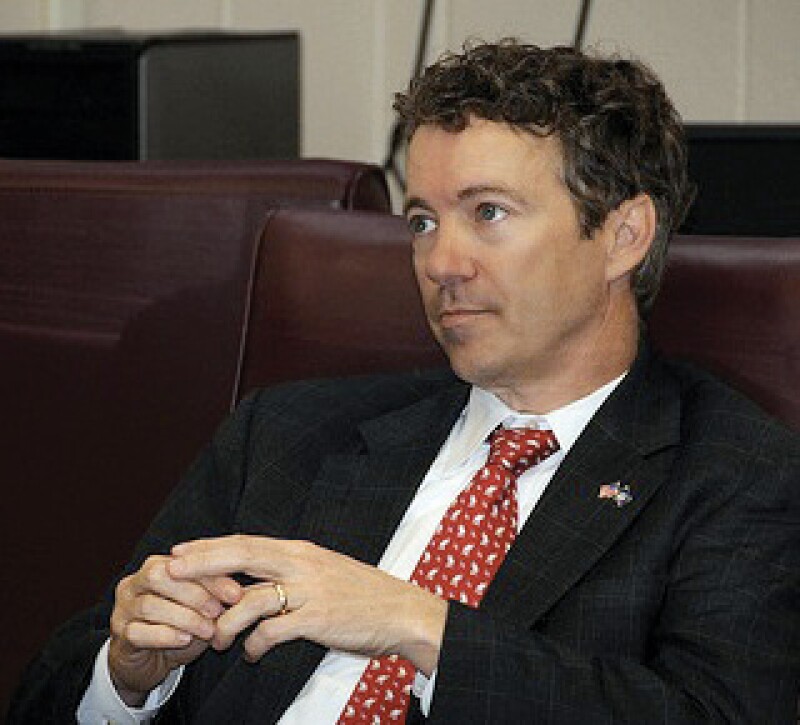
If the junior US senator from Kentucky did not make his mark in international tax before, he certainly made up for it in 2013, with three high-profile interventions which have earned him a place in the Global Tax 50. In May, Paul left no one in any doubt about how he felt about the Foreign Account Tax Compliance Act (FATCA), which requires foreign financial institutions (FFIs) to pass to the US certain information about their US account holders or pay a 30% withholding tax. He introduced a “Bill to repeal the violation of sovereign nations’ laws and privacy matters”. The legislation that Paul seeks to scrap has provoked a passionate reaction around the world. Most of it has slammed the US for what is seen as an attempt to have countries and FFIs collect tax on its behalf.
Do not expect Paul’s draft law to reach President Obama’s desk. It was sent to committee on May 7 and that is where it is stuck and is likely to be so forever. According to www.govtrack.us, a website that keeps up with the progress of all legislation through Congress, the Bill has 0% chance of getting through committee and the same chance of being signed by the president.
Later in May, as a member of the Permanent Subcommittee on Investigations, Paul railed against what he saw as the vilification of US multinationals because of their attempts to minimise their tax bills legally.
“Bringing in an individual company and vilifying them for doing something that is in every business' mandate is objectionable,” Paul said, during a hearing on offshore profit shifting on May 21 in which academics, Treasury officials and three executives from Apple, including Tim Cook, the chief executive officer, gave evidence.
Paul’s hold-up of Senate votes on tax treaties with Hungary, Luxembourg and Switzerland, which dates from when he became a senator in 2010, continues because he is concerned that they would give these governments too much access to US citizens’ information.
If its impact was the goal of this early frontrunner for the Republican presidential nomination in 2016, he certainly achieved it this year.
The Global Tax 50 2013 |
||
|---|---|---|
Jeffrey Owens |
Theo Poolen |
|








