On October 22 2019, the freshly elected Members of the European Parliament (MEPs) debated and tabled a motion for a resolution to ramp up pressure on EU member state governments regarding the pending proposal to amend Directive 2013/34/EU. The amendment, by way of a European Parliament and Council directive, would focus on the disclosure of income tax information by certain undertakings and branches, also known as public country-by-country reporting (CbCR).
Two days later, the non-binding resolution was adopted in the European Parliament by 572 votes in favour, 42 against and 21 abstentions. What is noteworthy, is that all the major political parties in the Parliament supported the motion. This was the first evidence that the extreme left wing and extreme right wing parties, which have all become stronger since the EU elections in May 2019, are seeing eye-to-eye across the aisle in demanding a more transparent and fairer taxation of multinationals.
In particular, in the resolution, MEPs recalled the adoption on July 4 2017 of the EU Parliament's common position, or mandate, for starting 'inter-institutional trilogue' negotiations with the Council of the EU (member states), aimed at hammering out a final compromise text. MEPs urgently called on the member states to break the deadlock within the Council and to conclude their first reading on the public CbCR proposal and to start inter-institutional negotiations with the EU Parliament in order to finalise the legislative process as soon as possible. They reiterated that the Council should respect the principle of sincere cooperation as laid down in Article 4(3) of the Treaty on European Union (TEU).
MEPs also urgently called on the Finnish EU Presidency to reopen and prioritise work on the public CbCR proposal based on the position adopted in the EU Parliament's first reading just before the EU elections. This would allow EU member state ambassadors to the EU, who prepare political agreements at Council level, to consider the proposal. Lastly, MEPs welcomed the fact that the incoming Von der Leyen Commission has reiterated its utmost support for a prompt adoption of the public CbCR proposal.
The Finnish EU Presidency had already planned a meeting of the Council Working Party on Company Law (CBCR) the following day, on October 25 2019, hence the timing of the MEPs' resolution. However, this Council technical working group meeting of national company law attachés did not lead to any shifts in individual EU member states' positions.
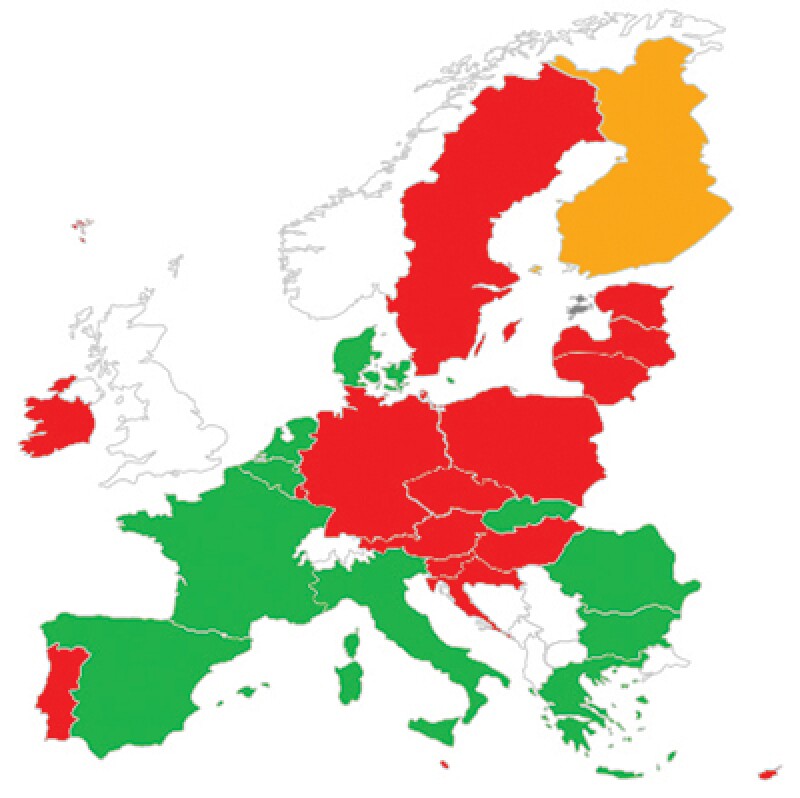
Figure 1
As reported previously, the European Commission's proposed public CbCR has divided EU member states from the start. In April 2018, a Council representative told the European Parliament that there were 'unresolved political issues' preventing agreement in Council. After a tweet by German Federal Finance Minister Olaf Scholz on September 12 2019 stating that he and his fellow Social-Democratic Party (SDP) Ministers within the German Coalition Government were unanimous in their support of public CbCR, there was some anticipation that there could be some movement in the German position, which is crucial for any progress. Yet, the impasse on public CbCR continues, and the chances that the draft Directive can be adopted at all on the current legal basis as chosen by the Commission (namely as an accounting/company law file rather than a tax file), seem to have diminished after the summer.
The map in Figure 1 shows the latest country positions. Indicated in red are 16 member states that are understood to be against and/or are insisting that the file should be changed into a tax file to allow for unanimous voting in the Council of the EU. The number of Member States in this camp seems to have grown considerably following the Commission's push for introducing qualified majority voting for certain taxation files. Depicted in green are 10 member states understood to be in favour who maintain that this is indeed a corporate reporting file which warrants an amendment to the EU's accounting Directive; a position that acknowledges that MEPs should co-decide with the Council. Lastly, Finland is understood to be undecided.
PwC | EU Public Affairs-Brussels (Tax | Tax Administration Consulting)
T: +31 6 130 96 296
E: bob.vandermade@pwc.com
W: www.pwc.com/eudtg