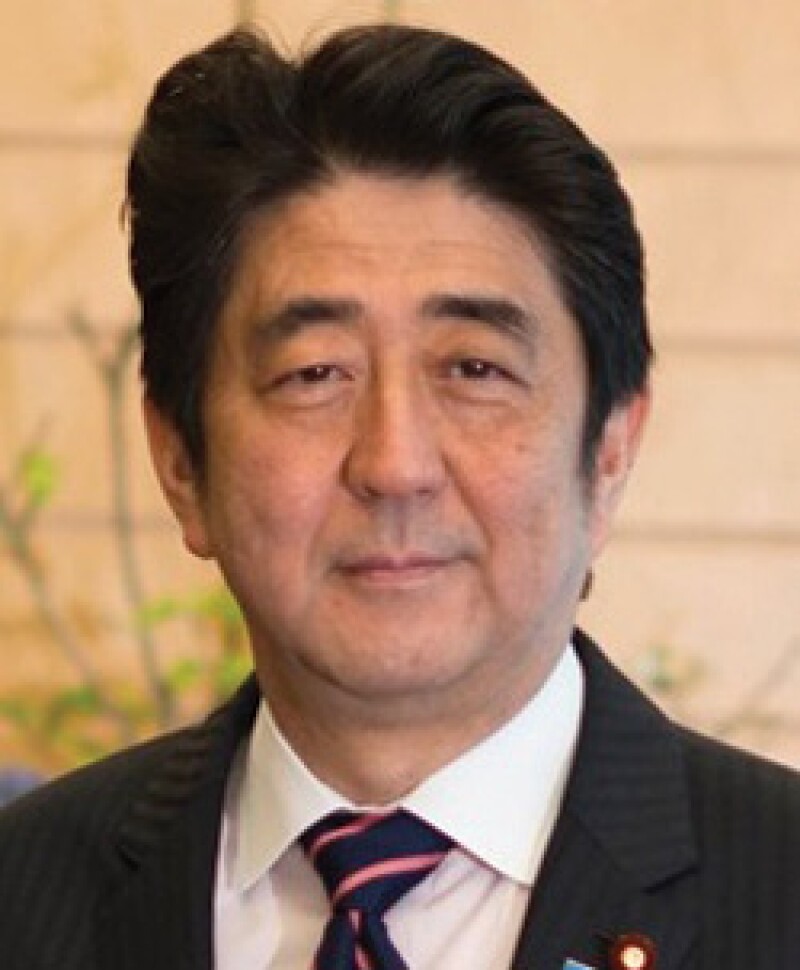
Shinzo Abe

International Tax Review is part of Legal Benchmarking Limited, 1-2 Paris Garden, London, SE1 8ND

Copyright © Legal Benchmarking Limited and its affiliated companies 2026

Accessibility | Terms of Use | Privacy Policy | Modern Slavery Statement

Shinzo Abe

Prime Minister, Japan

Shinzo Abe

Shinzo Abe has remained steadfast in his desire to implement tax reform measures in the face of opposition from members of his own Liberal Democratic Party and objections from some of his closest advisers.

His plan includes reducing Japan’s corporate tax rate, which stands at one of the highest in the world, and he also wants to implement a consumption tax rise. Japan’s room for manoeuvre and ability to implement reform were severely hampered by the 2011 Tohoku earthquake, which derailed the corporate tax cut contained in the Tax Reform Act 2011 and instead saw the implementation of a three-year surtax to assist the post-earthquake recovery.

But Abe has returned to the idea of tax reform time and again, and this year’s formation of a specialist reference group will do much to inspire confidence in the business community. Abe created the special task force, which includes the chief executive officers of eight large Japanese companies, and has charged it with advising on policies that could spur industrial competitiveness.

And in June, while an actual cut was not implemented, Abe announced that the framework for a future cut in the corporate tax rate was being installed. This has raised hope that the rate will be cut next year, or in 2015.

Abe has had the unenviable task of balancing the wishes of business with those of bodies such as the OECD during a time of national disaster recovery.

He heeded the OECD’s advice when the organisation in May said Japan is “poised for expansion” but that indirect tax hikes would be necessary to ensure economic growth in the country. As a result, the VAT rate will increase by three percentage points to 8% from April 2014.

Further reading

Japanese PM Abe still favours corporate tax cut

OECD calls for indirect tax hikes in Japan


The Global Tax 50 2013

« Previous

Tony Abbott

View the complete list

Next »

Tom Adams

more across site & shared bottom lb ros

More from across our site

The controversial deal will allow US-parented groups to be carved out from key aspects of pillar two
Awards
ITR invites tax firms, in-house teams, and tax professionals to make submissions for the 2027 World Tax rankings and the 2026 ITR Tax Awards globally
Pillar two was ‘weakened’ when it altered from a multinational convention agreement to simply national domestic law, Federico Bertocchi also argued
Imposing the tax on virtual assets is a measure that appears to have no legal, economic or statistical basis, one expert told ITR
The EU has seemingly capitulated to the US’s ‘side-by-side’ demands. This may be a win for the US, but the uncertainty has only just begun for pillar two
The £7.4m buyout marks MHA’s latest acquisition since listing on the London Stock Exchange earlier this year
ITR’s most prolific stories of the year charted public pillar two spats, the continued fallout from the PwC Australia tax leaks scandal, and a headline tax fraud trial
The climbdowns pave the way for a side-by-side deal to be concluded this week, as per the US Treasury secretary’s expectation; in other news, Taft added a 10-partner tax team
A vote to be held in 2026 could create Hogan Lovells Cadwalader, a $3.6bn giant with 3,100 lawyers across the Americas, EMEA and Asia Pacific
Foreign companies operating in Libya face source-based taxation even without a local presence. Multinationals must understand compliance obligations, withholding risks, and treaty relief to avoid costly surprises
Gift this article


