"What are you doing?" Often enough I say this to my kids when they are making a mess. Of course, their answer will be that they are playing. For them it is not a mess, it is a playground. What is daddy talking about? The issue here is that we are all reasoning from our own perspective. We are responding to the same occurrence, or input/impetus, but our views diverge based on our understanding of the context. Stepping into the shoes of the other side in a discussion helps to eradicate subjectivity and allows us to eliminate assumptions based on a more comprehensive grasp of the input/occurrence and the resulting views.
Today
In today's tax environment, the acronyms BEPS (which stands for base erosion and profit shifting, and has also become common parlance for describing the OECD's project of the same name) and CbC (country-by-country) or CbCR (country-by-country reporting) are used on a daily basis. The message is that we need to prepare for what is coming, whether it is the known or the unknown. We need to change our structures, we need to create and implement country-by-country reporting mechanisms, and we need to strengthen our tax risk management, among many others. There are so many initiatives from various advisers, like setting up webcasts and mailings, that I lost count; and BEPS remains a hot topic during conferences. The message is that we need to adapt to match the BEPS requirements and that this will be a massive exercise. It is as if we are entering a new era that we can't handle; there is so much to contend with in such a short time.
Foundation

|
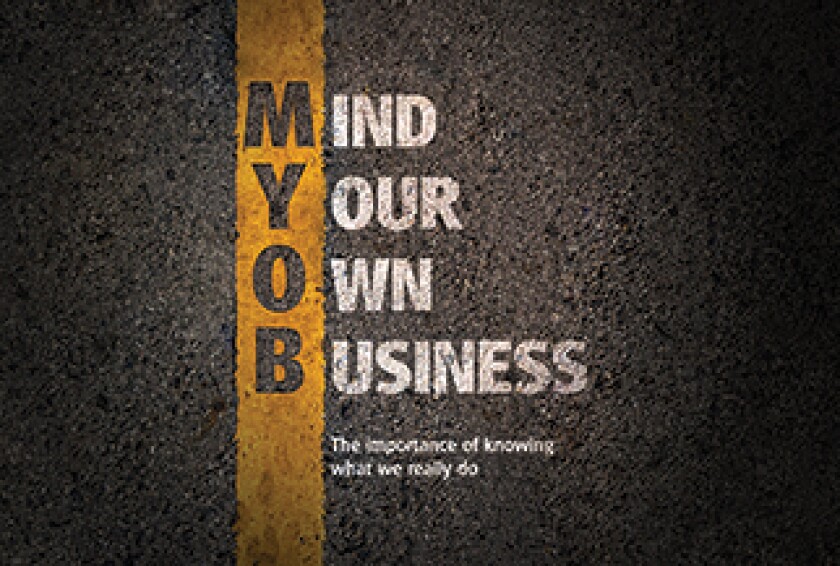
Truly ‘minding’ your own business means being mindful of all aspects. Accordingly, tax teams should intensify their cups of coffee with finance figures |
While we are still recovering from the economic crisis, BEPS being rolled-out and various governments trying to collect more taxes, most of the focus of in-house tax departments is on risk management and control. Basically this is the foundation of a tax department and the board expects that the tax department is aware of (and controlling) the various tax risks. However, by focussing mainly on the foundation, one might not see the overall value. Suppose you intend to buy a house: you don't buy the house because of its foundation, but you also won't buy the house because of its foundation. The foundations simply have to be solid, but the value lies in what you see.
The same goes for a company. Tax control and tax risk management represent the foundations. You don't want any surprises that have a negative effect on the financial result. You need to be in control. Some companies therefore have a tax control framework in place that provides guidance on their controls and risk management (and possibly tax reporting).
But by focussing merely on tax control framework items, one might miss out on value drivers, which are basically projects that have a positive effect on the financial result. Sufficient thought should therefore be given as to how the foundation can be a feeder for value drivers.
Road to success?
One of our first mission statements was that the tax department should move from corporate support to being a business partner and from business partner to 'being part of the business'. Only if you become part of the business can you really add value. To get there, you need to understand what your company does. This means having multiple cups of coffee with various colleagues. Let them talk. If you ask them what they want to achieve over the coming months, you often feel their passion and their drive. Why do they come to the office every morning? What makes them successful? Let them explain their drivers and their needs and let them share their views on the bottlenecks or potential obstacles to achieving those goals. Share the enthusiasm during the conversation. Try to talk their language. When you hear the various stories and their objectives for the coming months you can think about how you can help them. How can you make them shine? To be successful, you need to think from their perspective. Don't talk tax, talk business. Outside-in thinking is a fuel-efficient way of riding the road to success.
Tax as a value driver
Some time ago a CFO told me to be closer to the numbers and he repeated this message several times. I really thought that I was pretty close to the numbers as I did look at the financials on a regular basis and we did make calculations on the tax consequences of our projects and other activities. Despite that, it got to me. I started wondering what else I could do to get closer to the numbers; what did he mean? So my journey on numbers started…
I intensified my cups of coffee with finance people. I started reading articles not just about tax accounting, but accounting in general. How do we actually account for what we do? And then it got to me: we need finance to help us out. And we need to understand our business even better. Being part of the business actually means being at the true core of the business; being embedded in the organisation. Thus question how the transaction will affect the profit and loss account, balance sheet and/or cash flow. Will it hit the segment result or will it be booked directly into equity? What will be the effect on return on assets (ROA), return on net assets (RONA), return on invested capital (ROIC) or any other measurement used internally? We simply need to understand the impact on the financial accounts.
So do we actually know the cost of an asset? I think in most cases the answer is 'no'. For instance, if you buy a pair of shoes in the shop, you look at the price at the bottom of the tag. Hardly anybody looks at the VAT amount (if any). And at least the VAT amount is on the receipt. But what about any other taxes that are included in the cost price of those shoes?
The same goes for capital expenditures. Do we know how much import duty was due? Or import VAT? Or withholding taxes, stamp duties and other levies? There are a bunch of taxes included in the cost price of an asset that in essence are for the account of the buyer. By working closely with your colleagues, you can better understand what your company is doing. 'Do we know what we do?' means knowing what your company actually does. And to look at the bright side, in some cases there are subsidies and grants available, but I wonder how many of us really spend sufficient time applying for those.
Once you start analysing a transaction, whether it is the purchase of an asset, a service delivered or your commercial contracts, you will find more and more key elements that have an impact on the pricing. And once you know them, you can analyse whether you can mitigate any of those costs by doing things differently.

|
You don’t buy a house because of its foundation, but you also won’t buy the house because of its foundation. The foundations simply have to be solid, but the value lies in what you see. The same goes for a company. |
Tax value framework
To capture both the foundation and the value drivers, a company can decide to upgrade their tax control framework to a tax value framework. Such a framework will thus not only cover tax control and tax risk management, but also tax value that lies within various departments. Once you have a tax value framework in place, it essentially describes the business of your company and the underlying supply chains. One could even argue that employees that join your company – irrespective of their position within the company – should read this Tax Value Framework within the first three months to get a better understanding of what the company is doing.
The way I see it is that we (APM Terminals' tax team) are changing – slowly but steadily – the landscape of the tax environment we operate in. We are peeling the onion more and more to get to the core of our business. But rather than the drawing of tears associated with peeling a real onion, this should draw cheers once executives realise the extent of the extra efficiencies that can be achieved. We are talking to our commercial colleagues to understand the background of our revenue streams. Not on paper, but actually trying to understand what is happening in real life. The same goes for the other departments; what are we as a company actually doing? Which tools and programs do we use and which data do we use to make decisions? What is included in the cost price of an asset or a service?
This means we sit down with our external contractors to explain that we want to understand all the details and that we might want to do things differently to create value. It is about understanding the whole supply chain of the supplier and agreeing to adjust the process where deemed fit. It is a joint effort and requires transparency and trust. Value lies within the business. If the suppliers want to become successful on our joint journey, they need to adapt as well. And so the chain reaction starts.
Future
I do believe that we are entering a new era, but not one that is centred around BEPS. BEPS was, is and will continue to be the catalyst for change, changing our views on what is most important and, as a result, the view on tax structures will change from value to risk control. With BEPS as the catalyst, the new era will be about understanding the business and how to drive value from the core. To be successful, we need to understand what we do as a company; think outside-in versus inside-out. Tax is a consequence of what we do. As Charles Darwin once said, "it is not the strongest of the species that survive, nor the most intelligent, but the one most responsive to change". Now is the time to start working on that.