

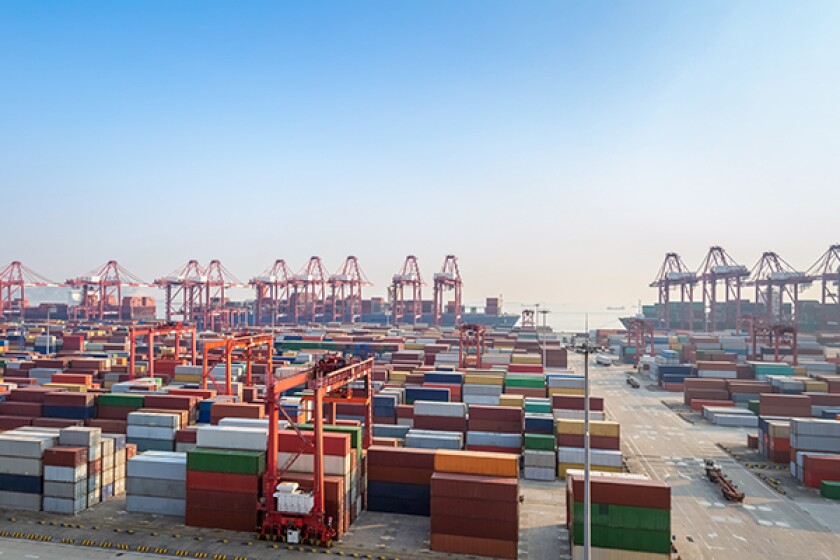
Since 2013 China has established an increasing number of free trade zones (FTZs) around the country. These serve as 'test beds' for investment liberalisation and streamlined regulation (for example, faster business registration, accelerated customs procedures, and so on). Tax incentives are also offered to businesses in the FTZs. Successful experiments in the FTZs are then frequently rolled out nationwide. In the first half of this year, China's 12 existing FTZs attracted foreign investment of nearly RMB 70 billion ($10 billion), that is, 14% of China's FDI.
Against a backdrop of several government measures to reform and stimulate the economy, August saw a flurry of FTZ-related policy announcements.
Six FTZs are to be established in Shandong, Jiangsu, Guangxi, Hebei, Yunnan and Heilongjiang. This brings the total to 18 together with the already existing FTZs in Shanghai, Guangdong, Tianjin, Fujian, Liaoning, Zhejiang, Henan, Hubei, Chongqing, Sichuan, Shaanxi and Hainan. Each of the new FTZs will have a particular focus, for example, Shandong FTZ will focus on the development of the marine economy, and Guangzxi FTZ on ASEAN region cooperation.
The Shanghai FTZ, which was the first FTZ to be established in 2013, is being expanded with the Lingang New Area. Major foreign investments, such as the new Tesla car factory, are already being made in the area. A special development fund of $14 billion will support infrastructure and talent investment, with tax incentives also announced:
A special corporate income tax (CIT) rate of 15% (standard 25%) will be available for five years for FTZ companies in advanced sectors (for example, integrated circuits, artificial intelligence (AI), biomedicine and civil aviation);
Beneficial individual income tax (IIT) policies will apply for foreign staff in FTZ companies. This will likely be modelled after the subsidy provided in the Guangdong-Hong Kong-Macau Greater Bay Area (GBA) which reduces the effective IIT rate to the level applying in Hong Kong; and
Customs handling is to be enhanced for FTZ imports and exports, establishment of cross-border e-commerce distribution platforms in the FTZ will be facilitated, and there will be further reductions in foreign investment limitations for certain sectors. This is on top of the recent reduction (effective July) of restricted sectors, in FTZs, to 37.
The so-called 'Certification-Licence Separation' pilot reform is to be rolled out from the Shanghai FTZ to all the existing FTZs from December 2019, and nationwide in the second half of 2020. This seeks to deal with the burdens faced by businesses from the multitude of approvals historically required, across different sectors, before a company could obtain its business licence and start operations. So, for example, distributors of cosmetics previously needed licensing pre-approvals for the importation of standard cosmetic products – under the pilot reform it now suffices that the distributor lodges a notification with the China Food and Drug Administration, so cutting the time to market. Before this, the reform was piloted for 116 licensing requirements in 10 of the FTZs. Now 523 similar licensing requirements will be cancelled, converted to notifications, or simplified for all 18 FTZs and then nationwide.
The FTZ in the Qianhai-Shekou area of Shenzhen is piloting new foreign exchange rules. Under these, a foreign invested enterprise (FIE) in the area will be generally permitted to use its foreign currency equity, converted to RMB, to invest in Chinese enterprises. At the moment, only a very limited number of FIEs (that is, those meeting the stringent requirements to be treated as China holding companies) can do so, so this could open the way to much increased use of onshore holding companies.
From January 2019, a 15% CIT rate will be provided for tourism industry enterprises in the Guangdong Hengqin New Area.
Beyond the FTZ-specific changes, the Shanghai government has also announced a liberalised regime for FIEs to be recognised as regional headquarters (RHQs) and receive associated benefits.
KPMG China
T: +86 10 8508 5002 and +86 10 8508 5001







