
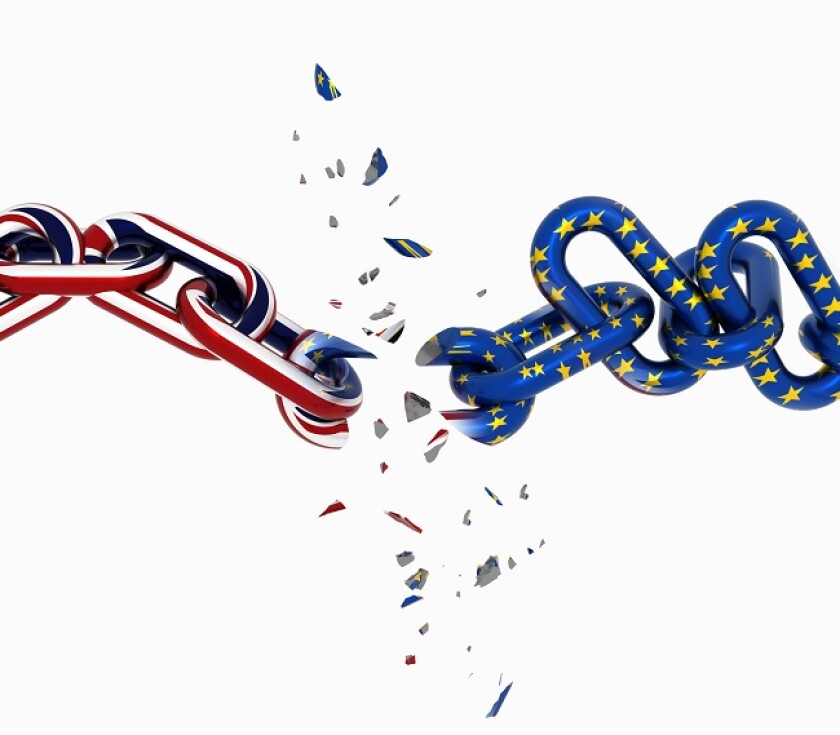
After the EU agreed to make several changes to the withdrawal agreement bill, the UK government faces the challenge of winning enough support from Parliament to make the proposal reality. The much-maligned Irish ‘backstop’ has been removed as part of the renegotiation in favour of a sea border. Many British and European businesses hope this will bring the stalemate to an end.
“I was impressed that they managed to come to an agreement,” said one indirect tax manager at a fresh goods producer. “It is still difficult for me to see how they are going to decide what the destination of goods are when they enter the ferry in the UK heading to Belfast.”
“It looks like Northern Ireland will align with the EU in the end,” he said, adding, “There will be some sort of duty refund for goods from the UK only if it can be proven the goods have been consumed”.
The Confederation of British Industry (CBI) said the deal “opens a pathway to a new UK/EU partnership”. Meanwhile the Institute of Directors (IoD) conducted a snap poll of UK business leaders and found that 55% think Parliament should back the deal, whereas 41% are opposed to the deal.
There may be divisions over the deal, but the business community would prefer it to leaving without a deal. If the deal goes ahead, the UK will enter a transition phase and be able to move to trade negotiations with the EU. This would mean much greater certainty about the future than in recent years.
Two customs regimes
With the removal of the backstop, the UK will leave the EU customs union and Northern Ireland will remain in the UK customs territory. This means no customs duties shall be payable for goods brought into Northern Ireland from another part of the UK direct transport, unless the goods are going to be taken back into the EU.
However, the territory of Northern Ireland will still align with EU rules to keep as open a border with Ireland as possible. This is dependent on approval from the Northern Ireland Assembly. The aim is to ensure that EU goods imported into the UK via Northern Ireland will be checked upon arrival at the British mainland instead of at the Irish border.
The EU will not collect customs duties from the UK, and Northern Ireland will be included in the territorial scope of any new trade agreements that the UK may secure with countries after the deal is secured.
When it comes to VAT, the new terms of the deal clarify that “the authorities of the UK shall be responsible for the collection of VAT and excise duties” in Northern Ireland. Revenues resulting from transactions taxable in Northern Ireland shall not be remitted to the EU, and will instead be kept by the UK.
Depending on the terms of Brexit, British companies that use MOSS will lose this option after Brexit. Such businesses may need to register with the EU’s non-union scheme in an EU member-state in order to continue benefiting from the scheme.
Once Britain leaves the EU, businesses will have 10 days following their first sale after Britain leaves to register for the MOSS scheme. However, British businesses will only be able to register for MOSS after the UK leaves the EU.
Third-party sellers that use MOSS today and are registered for it in the UK, will need to register for the scheme in another EU member-state if this deal becomes law. Depending on the outcome of Brexit, the third-party seller would then require a separate VAT registration in the UK.
These are just some of the issues around the Brexit deal that companies have to consider if the deal makes it through the House of Commons. This is where the political divides take precedence. Parliament could make or break this deal.
Removing the backstop
The multitude of issues surrounding the Irish border has made it a contentious point during the Brexit negotiations. It was one of the key reasons Theresa May’s deal was defeated three times.
First, May tried to make the case for a backstop between Northern Ireland and Ireland, but this came up against stiff opposition from the Democratic Unionist Party (DUP) – who propped up the Conservative government at the time. So May tried to resolve this by widening the backstop to include the rest of the UK. This would have effectively trapped the UK in a customs union with the EU with no clear exit mechanism and no end date.
However, the inescapable reality is that Northern Ireland and Ireland share a land border, and as such, there is the need to ensure frictionless trade across the two territories without undermining the customs and VAT standards on either side.
Although Johnson has managed to unite the Conservative Party around his deal, there is still doubt over whether or not it will pass. The DUP believe that the deal still treats Northern Ireland as separate to the rest of the UK, and party leader Arlene Foster has said that the DUP cannot support Johnson’s deal.
Opposition leader Jeremy Corbyn has called for Labour MPs to vote against the deal, describing it as “even worse” than Theresa May’s version of the deal. However, crucially, several Labour MPs have made it clear they will rebel against Corbyn and vote for the deal.
There is also the issue of how the growing number of independent MPs will vote, including the former Conservatives that were expelled from the party for not supporting the government.
If Parliament approves the deal, Prime Minister Johnson will have kept to his word on not creating a hard border on the island of Ireland. This deal will become the basis of a new relationship between the UK and the EU, but the next step will determine what the future looks like.
At the time of writing Parliament has not approved Boris Johnson’s revised deal, and as such, uncertainty remains over the future of Brexit, and the impact it will have on trade between the UK and the EU.


